Overview
Change Data Capture (CDC) is an architectural and data integration pattern used to detect changes in a database and propagate them to other systems. Instead of repeatedly copying entire tables, CDC captures only the data that has changed, such as inserted, updated, or deleted records.
CDC is commonly used in data synchronization, event-driven architectures, data replication, analytics pipelines, search indexing, and migration between databases. It is not a traditional Gang of Four object-oriented design pattern; it is better classified as an architectural integration pattern.
Change Detection
Identifies INSERT, UPDATE, and DELETE operations performed against source data. Depending on the implementation, changes may be read from transaction logs, detected by database triggers, or found through periodic queries.
Change Capture
Converts detected database changes into change records or events. A record may include the affected table, operation type, primary key, changed values, and source metadata.
Change Propagation
Delivers captured changes to downstream consumers, such as another database, a message broker, a search index, or an analytics platform.
How Does CDC Work?
The following diagram illustrates how Change Data Capture (CDC) captures database changes from transaction logs and propagates them to downstream systems through a message broker.
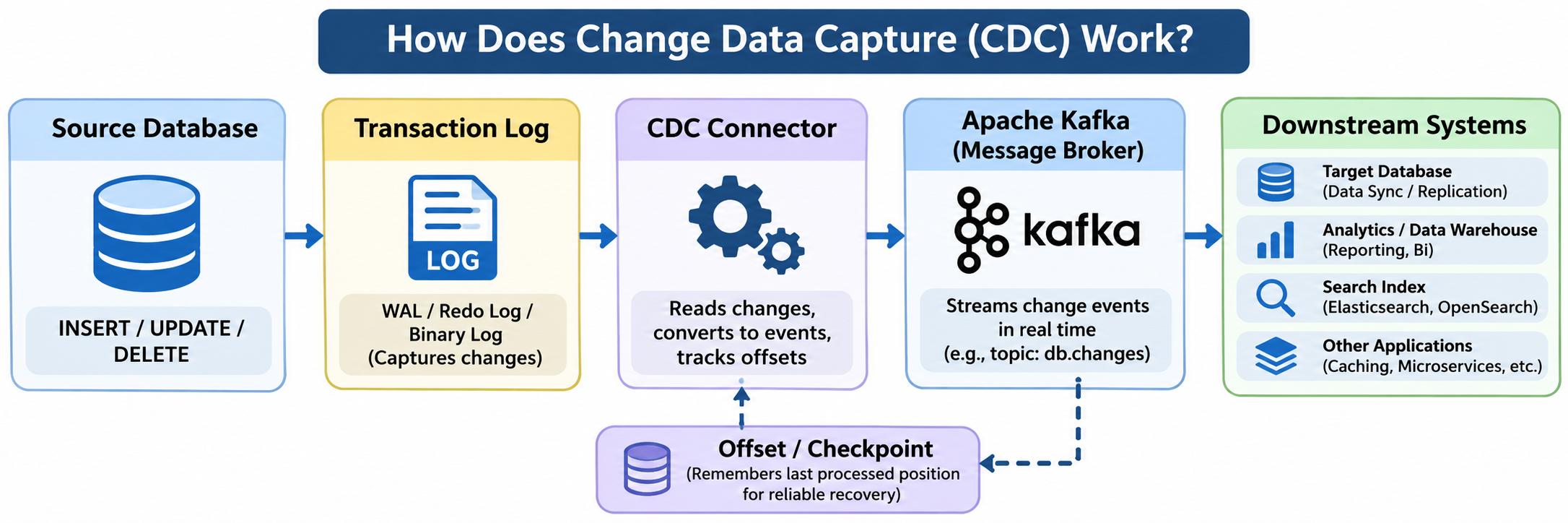
CDC Processing Flow
In a typical log-based CDC pipeline, a connector reads the database transaction log, converts relevant operations into change events, and publishes them for downstream applications to process.
The connector also tracks its reading position, commonly called an offset, log sequence number (LSN), or binlog position, depending on the database and connector. After a restart, it uses the saved position to resume reading. Correct checkpoint management is essential to avoid missing changes; duplicate delivery may still occur and should be handled safely.
Components and Responsibilities
| Component | Responsibilities |
|---|---|
| Source Database | Stores application data and records committed transactions. Its transaction log provides the change history used by log-based CDC. |
| Transaction Log | Records database changes for recovery and durability. A CDC connector can read relevant log entries without repeatedly querying every source table. |
| CDC Connector | Reads changes, interprets database-specific log records, converts them into structured events, and manages its progress through the source log. |
| Offset / Checkpoint | Stores the connector's last successfully processed source position so it can resume after a restart or failure. |
| Message Broker | Distributes change events to consumers and can buffer events between producers and downstream applications. It is optional; CDC events can also be delivered directly to a target. |
| Consumers / Targets | Apply changes to target databases, update search indexes, trigger workflows, or feed analytics and reporting systems. |
CDC Implementation Approaches
1. Log-Based CDC
Reads the database's transaction log, such as a write-ahead log, redo log, or binary log. It can capture committed changes with relatively low impact on application queries. This is a widely used approach for continuous, near-real-time data integration.
2. Trigger-Based CDC
Uses database triggers that execute when rows are inserted, updated, or deleted. The triggers typically write change information into separate audit or change tables, which another process reads and forwards.
3. Query-Based CDC (Polling)
Periodically queries source tables using a timestamp, version column, or another change indicator. This approach is relatively straightforward, but it may not reliably detect hard deletes unless additional tracking is implemented. Its latency depends on the polling interval.
| Approach | How It Works | Considerations |
|---|---|---|
| Log-Based | Reads database transaction logs. | Efficient for continuous capture, but depends on database log access, retention, and connector support. |
| Trigger-Based | Database triggers write changes to capture tables. | Can add write overhead and operational complexity to the source database. |
| Query-Based | Polls tables for rows with newer timestamps or versions. | Simple to implement, but can add query load and may miss deletes or intermediate changes. |
Simple Java CDC Event Processing Example
The following simplified example illustrates how an application might represent and process a CDC event after a connector has captured it. It is not a database log reader or a complete CDC connector implementation.
CDC Event
public class ChangeEvent {

    private String operation;
    private int recordId;
    private String newValue;

    public ChangeEvent(String operation, int recordId, String newValue) {
        this.operation = operation;
        this.recordId = recordId;
        this.newValue = newValue;
    }

    public String getOperation() {
        return operation;
    }

    public int getRecordId() {
        return recordId;
    }

    public String getNewValue() {
        return newValue;
    }
}
Change Event Consumer
public class ChangeEventConsumer {

    public void process(ChangeEvent event) {

        switch (event.getOperation()) {

            case "INSERT":
                System.out.println(
                    "Insert record: " + event.getRecordId());
                break;

            case "UPDATE":
                System.out.println(
                    "Update record: " + event.getRecordId()
                    + ", value: " + event.getNewValue());
                break;

            case "DELETE":
                System.out.println(
                    "Delete record: " + event.getRecordId());
                break;

            default:
                throw new IllegalArgumentException(
                    "Unsupported operation: " + event.getOperation());
        }
    }
}
Using the Consumer
public class CDCExample {

    public static void main(String[] args) {

        ChangeEventConsumer consumer = new ChangeEventConsumer();

        ChangeEvent event =
            new ChangeEvent("UPDATE", 101, "Updated Value");

        consumer.process(event);
    }
}
In a production system, the event would normally be supplied by a CDC connector or message broker. The consumer would also need error handling, schema management, retry policies, and idempotent processing.
Offsets, Checkpoints, and Reliability
A CDC connector must remember how far it has read in the source transaction log. This position is stored as an offset or checkpoint. For example, a database may expose a log sequence number (LSN) or binary log file and position.
| Concept | Explanation |
|---|---|
| Offset / Log Position | Identifies a position in the source log from which the connector can continue reading. |
| Checkpoint | Persists progress so a connector can recover after a restart. |
| At-Least-Once Delivery | Events may be delivered more than once, so consumers should be designed to handle duplicates. |
| Idempotency | Processing the same event again does not create an unintended additional effect. |
| Ordering | Consumers may need to preserve the order of changes for the same record or partition. |
| Log Retention | Source logs must remain available long enough for the connector to catch up after downtime. |
A key design consideration is coordinating event delivery and checkpoint advancement. If a connector advances its checkpoint before changes are safely delivered, events could be lost. If it delivers events and fails before saving progress, some events may be delivered again. This is why duplicate-safe consumers and carefully designed recovery behavior are important.
Advantages of CDC
- Captures only changed data instead of repeatedly copying entire tables.
- Enables near-real-time data synchronization between systems.
- Supports event-driven architectures and asynchronous processing.
- Can reduce polling queries and unnecessary load on source databases, particularly with log-based CDC.
- Helps keep analytics platforms, search indexes, and read models up to date.
- Supports database migration and replication use cases.
- Decouples source applications from downstream consumers when used with a message broker.
Disadvantages and Challenges of CDC
- Log-based CDC requires access to database logs and database-specific configuration.
- Connectors and pipelines introduce additional infrastructure and operational complexity.
- Consumers must handle duplicate events, retries, and failures safely.
- Schema changes in source tables can affect connectors and downstream consumers.
- Source log retention must be sufficient to cover connector outages and recovery.
- Maintaining ordering across partitions or multiple tables can be challenging.
- Monitoring lag, throughput, errors, and data consistency requires ongoing operational effort.
Where CDC is Used
| Technology / System | Usage |
|---|---|
| Debezium | Open-source CDC platform that captures database changes and commonly publishes them to Apache Kafka. |
| Apache Kafka | Distributes CDC events to multiple consumers through topics. |
| Oracle Database | Redo-log-based change capture can be used by supported CDC tools and integrations. |
| MySQL | Binary-log-based capture can stream row-level changes to downstream systems. |
| PostgreSQL | Logical decoding and replication slots expose database changes to CDC consumers. |
| Data Warehouses / Analytics | Incrementally propagates operational database changes into analytical systems. |
| Search Platforms | Keeps search indexes synchronized with changes in application databases. |